This
essay is about the persistent and obdurate misunderstanding of two
things that history cannot do without: the concept of truth and the kind
of inferential exposition or argument that we call narrative. It is as
if people want to make life interesting, or they want to sound original,
so they misconstrue truth and narrative. Being wrong is not original,
and in the process of getting things wrong they make them dull and
predictable. They also forget just how much philosophers have been able
to say about truth - this essay is a reminder - and just how important
truth is to logic, and logic is to narrative.
Essay 5. Truth and Historical Narrative
Monday, January 24, 2011

Wednesday, January 12, 2011
Drawing From The Wrong Side Of Your Brain
It seems like this is the latest golden age of
radio. I heard this fable of Aesop’s yesterday on a download from CBC Canada.
Jonathan Goldstein told it on Wiretap. It’s called The Bat and The
Weasels:
"A bat was out flying one day when he fell to the ground. Lying on the
ground he was immediately caught by a weasel. The bat pleaded for his life, but
the weasel refused his pleas telling the bat that he was by nature an enemy to
all birds. Hearing this the bat assured him that he was not a bird but a mouse,
a flying mouse. And thus the weasel set the bat free. Shortly afterwards, the
bat, while out flying again, fell to the earth once more, where he was again
caught by another weasel. (This is a completely different weasel) Once again
the bat begged this other weasel for his life, explaining that he was in fact
not a bird but a mouse. But this time, this other weasel told the bat that not
only did he hate birds but he also had a special hatred for mice. Hearing this the
bat then assured the weasel that he was neither a bird nor a mouse but a bat.
And thus for a second time the bat escaped."
That’s
the end? What kind of story is that? When asked what it meant, most of the
people on Wiretap were at a loss. First up Jonathan’s colleague Howard
ventured that it was like a koan, one of those impenetrable little Zen fables.
You know the sort of thing: Two hands clap and there is a
sound. What is the sound of one hand? After time to gather his wits he concluded that it wasn’t a
very good story. Among others there was Rabbi Popko who saw it as a story about
survival versus dishonour. Personally, I like the way the bat does two
different things and they both work at least (and maybe only) once. I think
maybe the rabbi said something like this too. Before I listened to the download
there was something on the Wiretap web page that made me expect that
around about now there was going to be something about a Jew surviving by
telling one Nazi he was Polish or something and telling another Nazi he was a
Jew. But there wasn’t. After the rabbi came a writer, it might have been John
Hodgman I think. He trashes the little story. It’s a terrible, terrible fable.
To illustrate he retells it as a bad joke. Something like this: Two weasels go
into a bar. Bat is the bartender. One weasel says I hate birds. The other
weasel says I hate birds and I also hate mice. Bat says good thing I’m a bat.
The moral of telling it this way was: Just as the joke fails because it isn’t
funny, the fable fails because it has no moral lesson, no take away. This
possible John Hodgman said he would not include this fable in The Book.
Jonathan phoned Laura Gibbs, a translator of Aesop,
and she said that the fables have been handed down just as summaries. On the
page they have been torn out from their context in a living oral story-telling
tradition. People like lawyers would have used compendiums of fables as a
source for their speeches. I guess the lawyers could adapt a fable to their
case. (Jonathan, by the way, was using his Aesop for his insomnia). For the
record here’s Laura’s translation from Oxford University Press’s Aesop’s
Fables (2008):
"A bat had fallen to the
ground where a weasel grabbed her and was ready to kill her. The bat begged for
mercy but the weasel refused, since weasels are the natural enemies of every
kind of bird. The bat insisted that she was not a bird at all, but only a
mouse, so the weasel let her go. Later on, the bat fell to the ground again and
was seized by another weasel. The bat also begged this weasel not to kill her,
but the weasel refused, since there was a war between the mice and the weasels.
The bat denied that she was a mouse, but only a bat, so once again the weasel
let her go. As a result, the bat was able to save herself twice by changing her
name."
Clearly we must not always
stick to the same course all the time since people who change with the times
are often able to escape even the greatest dangers.
Gender issues. War between mice and weasels.
Changing names. It is always good to see a different version of a fable. The
littlest changes remind you that the art and the moral is all in the retelling.
Yes it’s got a moral too. A take away. Whose privilege I wonder is it to tack
that on? Aesop’s or the reteller’s? Aesop, whoever or whatever he was, is now
the product of telling and retelling and retelling. It’s called Aesopica and
that’s all Aesop really is anymore. Fables only live in being retold. All of
culture’s like that really. It’s like life: it survives and evolves only in reproduction.
Cultures that ban their re-imagination annihilate themselves. Versions of these
stories have been told here and there all throughout Indo-European culture. The
animals change, the morals change and no-one can tell anymore who Aesop was or
who the Ur-Aesop was and whether he or she was the same Ur-Aesop who gave the
indigenous cultures of Australia and America their versions too. Do we all get
our stories from the same Ur-Aesop or are all our stories so similar because
they respond to the same human interests?
Laura thought The Bat and The Weasels had now
become, if not dead, then decrepit. It had become a kind of cultural dead-end.
And Jonathan ended Wiretap by having a go at reviving it. He went for a
modern version about a bat, the child of pigeon and a mouse, who discovers its
identity as a bat. It is too long for here (you can listen to it on line) too
elaborate, and not as good as the joke, which is maybe at least sort of funny
and definitely good storytelling. Its brevity gives it semantic leverage.
Jonathan’s real contribution to story-telling is the whole beautiful episode of
Wiretap.
Just one other thing about the
responses. It was the comfort respondents took in quibbling, things like: this
bat was not a good flyer; these weasels weren’t as cunning as weasels are
supposed to be; weasels, like everyone else, don’t eat birds because they hate
them, they eat them because they like eating them. There must be something
important going on here. But maybe that’s another story. I wanted to say that
usually these stories go in threes. Three weasels would walk into a bar. What
would have happened when the bat fell to the ground a third time? By the way,
Rabbi Popko reminded us that the German for bat is fliedermaus, flying
mouse. I wanted to say, flying fox is English for bat, at least where I live.
Not really quibbles. Footnotes.
Anyway now I have to say how
beautiful this fable is, what brilliant story-telling. No moral tacked on the
end could ever do it justice. Of course there is not much point acting like a
mouse and being terrified of weasels, when you could just be hanging out like a
bat instead, but what is the point of saying that. The fable is a
wonderful distillation, so clear people seem to look right through it and see
nothing, its spirit and meaning so strong that people don’t get it without
watering it down in elaboration. That’s what good fables are: indeterminately
short. Like bits of string that you keep in a jar for when you need them.
I am starting to get some idea of
what the take away of this essay might be. I think it’s something to do with
the assumption that a lot of people make that this fable rather than being all
Zen and Koanic, is just not very good or sort of derelict. Like the West or
modernity. The Bat and The Weasels though reminds me of those little
stories Franz Kafka told. The maybe-not-very-good ones. Not Zen, more Jewish I
guess, or greekjew as James Joyce might have said. Here’s one called A
Little Fable:
"'Alas,'
said the mouse, 'the whole world is growing smaller every day. At the
beginning it was so big that I was afraid, I kept running and running, and I
was glad when I saw walls far away to the right and left, but these long walls
have narrowed so quickly that I am in the last chamber already, and there in the
corner stands the trap that I must run into.'
'You
only need to change your direction,' said the cat, and ate it up."
Is
this a story or an aborted story? It sounds a bit like The Trial in one
hundred words or less. In another one of Kafka’s little stories someone says
‘All these little parables really set out to say merely that the
incomprehensible is incomprehensible, and we know that already.’
So
I was talking about The Bat and The Weasel with two friends. And the
conversation being conversation got around to being about something else. One
friend’s mother had wanted to draw so she enrolled in a course called Drawing
From The Right Side of The Brain. You know the kind of thing. Creative adult
education. Lesson One: The master puts pencil and paper in front of the pupils
and says draw this. It was a copy of one of those pictures of a lamp base or a
vase that also looks like the profile of a face (or two faces) or something.
Whatever it is it is a bit tricky. That’s the point. They use them in
first year Psychology courses. A Rubin vase I think it’s called. I think it’s a
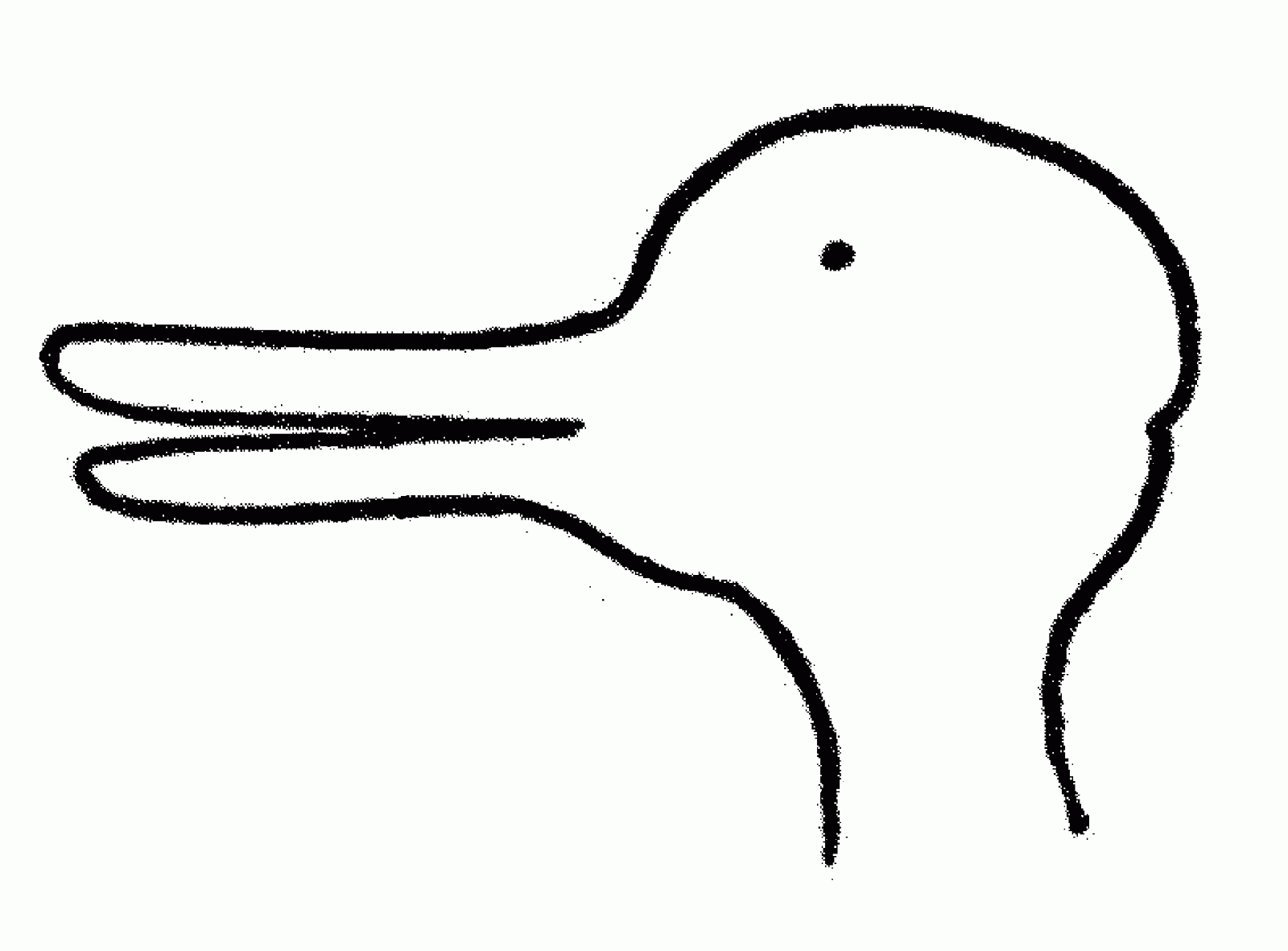
figure-ground thing. But maybe it’s a right-side/wrong side thing too. (Ludwig
Wittgenstein could have used his duckrabbit picture if he’d got the job of
drawing master. It’s either a gormless duck or a puzzled rabbit looking into
the wind.) Friend’s mother didn’t know where to start. That was why she was
doing Drawing From Right Side of The Brain in the first place. Just draw what
you see said the master.
As
it turned out Lesson One was a replay of one of friend’s mother’s nightmares.
It was like when she was a child and a teacher had stuck a pencil and paper in
front of her and had said draw a map of Australia, and when she had primal
drawer’s block, the teacher just told her again to draw it, anyone can draw a
map of Australia. (On its side it looks a bit like a duck or a rabbit, or a
cranky drawing master) This is where the story gets terrible. It’s a whole
other story. My friend’s mother was pretty upset about having to learn all over
again how not to draw. She went out into her garden. She had a beautiful
garden. She slipped climbing up a little wall, crushed a vertebra. It was like
the beginning of the end for my friend’s mother. The fate of the drawing master
is another story. Gossip.
Now while all this was happening I had been thinking
about mentors. Mentor was a guy who walked out of the pages of The Odyssey
and became a common English noun around the middle of the eighteenth century.
By the end of the twentieth he had become a verb and then a gerund, and with
that a new institution: the mentoring program.
In The Odyssey Mentor is in loco parentis
to Telemachus whose father Odysseus is away at the Trojan War. Mentor is the
wise counsellor. Now one thing that is a bit funny about Mentor is that in most
of his scenes Mentor is not quite himself. Athena, the wise and bright-eyed
goddess, assumes Mentor’s aged form and voice. She or he encourages Telemachus
to journey in search of his father, eggs Odysseus on against his enemies back home
in Ithaca, and even ends up establishing peace at the end of the whole show.
It’s the wise counsellor role that has come into the
lingo. The zeitgeist has it that what we call young people (and probably young
men especially) are now peculiarly susceptible to being fatherless. Divorce,
the crisis of masculinity, feminist triumph, you know. Happily Mentor was there
in the wings of tradition to provide the solution and take the place of the
absent father.
Tradition, that revered and obscure father to us all,
is partly what mentoring is all about. How better to recapture that now absent
father than by the managed folksiness of mentoring. How better to become
re-enchanted. The zeitgeist has figured out that education is now alienated
from experience. Experience, if you’re young, is disaffected. As for basing
education on pop psychology about learning styles — that’s light on supporting
evidence and it ends up with the same old alienation affect anyway. Even
‘visual kinaesthetic’ learners are bored with colour and movement. So here we
all are longing for those old tribal ceremonies that recognised and celebrated
the stages of authentic life. High school isn’t a proper initiation, nor is
university, apprenticeships are hard to come by, vandalism and gang behaviour
are antisocial, and adolescent circumcision is too drastic. So let’s mentor. We
can extend it to life-long learning too. We could mentor drawing from the right
side of the brain. And we could have a mentoring task force to fight the war in
Afghanistan. In fact we do.
Once the verb ‘to mentor’ appeared with its promise
of a society re-enchanted by wisdom and informal but managed instruction, it
wasn’t long before the gerund appeared as evidence that a maybe innocent desire
had spawned a demented offspring. What was once a happy relation between humans
became a manufactured contrivance. Soon there were mentoring programs.
Meanwhile, no one sounded entirely comfortable pronouncing the last syllable of
mentor. It was too much like the unstressed ‘-er’ ending that English uses to
turn a verb into its agent. So no one should have been surprised when the
person mentored became the mentee. It had come to this.
I don’t think I ever had much in the way of a
mentor, but maybe that was the point of a mentor. It was a pretty informal
thing. Maybe you weren’t supposed to realise you’d had one until it was all
over. Maybe like Telemachus you didn’t really realise you’d had one at all.
Besides, Mentor wasn’t a real mentor anyway. That was Athena. And she wasn’t a
proper male role model. Anyway I used to think that a mentor sounded like not a
bad idea. It had sounded pretty good in The Odyssey for a good two
thousand years.
Today
I read a quote from King Lear: Give me an ounce of civet, good apothecary, to
sweeten my imagination. It’s in that scene on the cliff at Dover, just after
Gloucester jumps. How did Shakespeare just keep on coming up with this stuff.
What side of his brain was he coming from. Anyway like the troubled
King, I just want an ounce of civet. I don’t really want imagination being
turned into consolation, creativity into therapy, Mentor into a mentoring
program. I can do without the pitch.
Enough.
That’s it, that’s the essay about Aesop, The Wrong Side of The Brain and
Mentoring. If I start to explain how they go together, I’ll just complicate it
like I did with the thing about King Lear. What’s he got to do with it? It’s
like trying to draw a rabbit and ending up with a duck that looks sort of like
a map of Australia with two Cape Yorks. I just know they go together. An essay
can say anything but it can’t say everything. It wouldn’t want to. Like one of
Aesop’s fables an essay is finished when it feels it’s said enough.
But there’s the moral of
course and I can’t do better than Aesop for that. A bat falls to the ground and
gets caught by a fox. When the bat begs for his life, the fox refuses, saying
that he is by nature the enemy of all birds. The bat assures the fox that he is
not a bird, but a fox. And the fox spares the bat’s life. Some time later the
bat is going somewhere crawling on the ground this time, just in case, and gets
caught by another fox. When the bat begs the fox for his life this fox says he
hates other foxes. So the bat assures the fox that he is not a fox but a bat.
The fox says no your not, you’re a crawling fox, and eats the bat.
OK.
So there is more. Of course there is. There is the third friend, the one I tell
The Bat and The Weasels to after I think all this is over. First I tell
him my version of Jonathan’s version of Aesop’s version. It’s Friday afternoon.
He’s just finished doing something meaningless. Anything would amuse him. And
he is amused. Or polite. So then I tell him the one about two weasels walk into
a bar. He’s even laughing. So now he tells me a joke. Why do Irish scuba divers
roll out of the boat backwards. It’s an Irish joke he says. Why I wonder. I
really want to know. Because if they rolled forwards they’d end up in the boat.
Monday, October 11, 2010
Writing and History. Essay 2 of Philosophy of History for the Time Being
For history to happen something like writing, which combines durability and replicability, narrative and specific denotation, had to be invented. Of course it’s not just writing as such that is needed, but recorded language, whether it’s in the visual text we call print or the audio ‘text’ of a voice recording. Speech alone is not a record, or at least it’s only a fleeting record written on air. I expect the evolution of media will continue to change the media of history.
Essay 2. Writing and History
Thursday, September 23, 2010
Kicking Stones, Acts, Processes and Other Events: Essay 3 of Philosophy of History for the Time Being
The third of seven essays on philosophy of history. Until we start to think about what an event is we don't realize what odd things events are. As soon as we start talking about history we imply some theory of events, but we seldom make that theory explicit. So this is not the definitive theory of events; rather it's a description of a theory of events that lurks in ordinary modern historical consciousness. Accordingly this essay offers a kind of taxonomy of events, which classifies events by how we observe them. It also considers the problems of identifying and differentiating one event from another. Basic stuff.
Essay 3. Kicking Stones, Acts, Processes and Other Events
Wednesday, September 22, 2010
A Long Hard Look At An Event, The Latham-Howard Handshake: Essay 4 of Philosophy of History For The Time Being
The fourth essay of Philosophy of History For The Time Being examines a single event to show how wonderfully ambiguous a thing an event can be. It chooses it's example carefully - an event that's very stale news (if you follow Australian politics - otherwise it would never have been news), an event whose identity is maybe almost fixed now as far as definitive history is concerned, but an event that is of such monumental banality that it's a matter of great wonder that it has not disappeared altogether from
historical recollection: it's the famous handshake between Mark Latham (Leader of the Opposition) and John Howard (Prime Minister).
Essay 4. A Long Hard Look at an Event, The Latham-Howard Handshake
Saturday, September 18, 2010
Philosophy Of History For The Time Being
This is the first of a series of essays and footnotes around the traps of history and philosophy
of history. They try to address the questions of philosophy of
history, popular or otherwise, but not head on. So they aren't about the History Wars, or whether history is
fiction, or about whether 'young people' lack historical
consciousness. Instead they are about neglected or misunderstood notions that frame
historical consciousness.
I think that important concepts like act, event, fact,
truth, narrative, writing, actual footage, media and selection are often
used in thinking about history but that they get seldom get the attention
they need. Except maybe for cinephiles or media theorists, I doubt whether actual
footage is even much thought of as an important concept for the philosophy
of history. If only because of the pre-eminent role of media in driving the history
of history, I doubt whether there is a more important concept. Because they are
all such everyday concepts, they might scarcely seem worthy of philosophy. They
look banal not profound. As is the case with many of philosophy’s objects most
people think they just understand these things already anyway; they are a
birthright and they become the unquestioned building blocks of theories about
history rather than being treated as the objects of inquiry. If they have been
scrutinised, critique has done its work on them, and now they come with a
pretext for disregarding or discarding them. Sometimes I think they are just
misunderstood, sometimes misused or abused. When people start to get
philosophical about history the terms often seem to be used, unconsciously or
in some cases even deliberately, as innocent looking props diverting our
attention from theoretical trickery or received doctrine. Even though most of
the terms are well known to philosophical reflection, far too much of the
serious thought that philosophy has given to them is ignored when
philosophising about history.
I have written these essays because I could not find
philosophy of history or theories of history that reflected on these concepts
to my satisfaction. I’ve written about what I would have liked to read about. I
now hope I find a reader who also wants to read about what I wanted to read
about.
.Essay 1. Philosophy of History For The Time Being
Saturday, October 10, 2009
What Is Fiction?
Some mistakes pervade our whole lives. Everything we say about something, even though it might be the most everyday part of our lives, is wrong because we all seem to be born into a kind of a common cloudland. We are deluded right from the start, right down to the soles of our feet, into the deepest recesses of our hearts and minds. For all our care and precision, when we talk about fiction, we are like birds pecking at reflections in a window.
In How Fiction Works1 James Wood quotes Roland Barthes: ‘The function of narrative is not to “represent”, it is to constitute a spectacle still very enigmatic for us but in any case not of a mimetic order… “What takes place” in narrative is, from the referential (reality) point of view literally nothing: “what happens” is language alone, the adventure of language, the unceasing celebration of its coming.’ From here Wood proceeds: ‘Now to charge fiction with conventionality is one thing; to move from this charge to the very sceptical conclusion that fictive convention can therefore never convey anything real, that narrative represents “literally nothing”, is incoherent.’
Now I could proceed like this: Barthes is already in the cloudland having fun trying to chase the clouds away —the ones about narrative being mimetic. (I could call these Aristotles’ clouds, after all he’s the one who called fiction mimetic in the first place.) Barthes does this by generating more of his own clouds: the line about what takes place in narrative being ‘literally nothing’; and the line about ‘“what happens” is language alone’. Along comes Wood and seeing how cloudy things seem to be getting begins trying to sort things out a bit by deciding that the cloud Barthes means by ‘narrative’ is ‘fiction’ (It probably is; people are always using the words ‘narrative’ and ‘literature’ in rather cloudy ways to mean fiction). Since Wood is responding here to the critique of the conventions of realism, he launches his own cloud and glides along on it to chase another cloud which looks like one of Barthes but is actually only a cloudy reflection of one of Barthes — the one about fictive convention never conveying anything real. All this is in the last section of Wood’s long, easy essay, where, eventually growing weary of chasing clouds, Wood has had enough: ‘So let’s ‘replace the always problematic word “realism” with the much more problematic word truth’. An awful lot of people writing about fiction have ended up doing this. The ‘still very enigmatic spectacle’ of fiction notwithstanding, the problems of what realism is notwithstanding, fiction is in one way or another, true. It’s just true.
Enough. Let’s just ask some obvious questions. Is fiction mimetic? What does a fiction refer to? Can we say a fictional narrative is true? What is fiction? Is fiction mimetic? Yes, it represents whatever it is about by the use of likenesses of what it is about. Fiction is a likeness of narrative; literary fiction is a likeness of what people say or write. Let’s be quite clear about this. The whole of a novel is a likeness of a story about all the characters in the novel, or perhaps many stories, for a novel is made of likenesses of many stories, and these likenesses includes lots of other likenesses, likeness of how the characters speak or write, likenesses of how people in that society speak, likenesses of other stories or bits of stories. Fiction is a mimesis of life, primarily in the sense that it is mimesis of linguistic and narrative life. What does a fiction refer to? Linguistic and narrative life.2 Why is this so hard to grasp? Why do we ignore it and peck at the reflection in the window? Why do we chase clouds around? Wood quotes George Eliot: ‘Art is the nearest thing to life’. And then adds, ‘The great Victorian realist is being precise here: art is not life itself’. He is very wrong. Art is part of life itself. How strange that so many people, especially those who know art is an important part of their lives, can think art is not part of their lives. Art is life at its liveliest, life at its most eloquently social. Wood quotes Eliot saying almost just this: ‘It is a mode of amplifying experience and extending our contact with our fellowman beyond the bounds of our personal lot’. We are living when we do art. Narratives, fiction or non-fiction, are part of life too. All our speech and writing, all our stories are part of life. So when I say fiction is a mimesis of life, if you are used to thinking that narrative or perhaps rather narrative art, is not part of life but somehow something other than life, then you will have trouble getting the simple idea that fiction is the mimesis of life, of linguistic and narrative life. And you will have trouble understanding that narrative life, and indeed the whole of our linguistic life, which is just about the most important thing we live, because as hyper linguistic social animals we live nearly all our lives in, by and through language and narrative, is a pretty significant part of life as we know it.
This answers another question that people might have: Isn’t it trivial to explain something as profound as fiction this way?3 What we say and tell is one of the most important parts of our life. We either do things with words or we talk about them. Wallace Stevens said ‘life consists of propositions about life’. Wood says that ‘round’ characters are impossible in fiction, ‘because fictional characters, while very much alive, are not the same as real people’. I would say that fictional characters are only alive in a metaphorical sense — that is if the narrative artist can render them well. And I would add that a lot of real people, living or dead, are only known to us through written characterisation. Abraham Lincoln, apart from a few photos, is no less literary than Leopold Bloom. What Barthes called ‘language alone’ is anything but ‘literally nothing’. Our great actions are mostly linguistic, social actions, and when they aren’t, we can’t help talking about them.
We seem habituated to separating art from life, the way we separate language from reality, culture from nature, reason from passion, all when art is life at its liveliest, language is reality at its most astonishing, reflecting itself, culture is nature at its most exquisite, reason is passion at its most profound and urgent. Many would find this ridiculous, but that is partly because we are so inured to separating these things, and we are so ready to load one or another of these pairs with the judgement that it is somehow more authentic than the other because it came first or is more down to earth. It is precisely because art is an outstanding state of life (just as language is of reality, or culture of nature, or reason of passion) that we felt the need in the first place to say that art is of a different kind from life (or language is from reality, culture from nature, reason from passion).
Can we say fiction is true (and I mean true in a strict logical sense and not the metaphorical or vague sense that we sometimes use in statements like ‘moral truth’)? Yes, but to explain why, we need to consider how mimetic narrative can be true, bearing in mind that we use the word true (or false) of things like assertions, claims, statements, and beliefs.4
So how does mimetic narrative, which is about people that don’t exist and events that never happened, make a truth claim? It does not make a truth claim about the events in the world of the fiction. It does not claim things like that there was a man named Leopold Bloom who was married to Molly who wandered around Dublin on 16 June 1904 eventually to meet up with someone named Stephen at a brothel and a bus shelter before going home where Molly was dreaming away in bed. So far as this sort of truth is concerned, fiction is only true by being frankly false. As mimetic, fiction shows what it tells and what is true are the claims made, often only by implication, of this act of claiming by showing. Fiction makes truth claims about the language and narratives it shows: ‘Here is a story about a man in Dublin’, ‘Here is what someone or many people might have said about such and such’.
Joyce’s story The Dead begins ‘Lily, the caretaker’s daughter, was literally run off her feet’. We read a truth claim about the character Lily’s state as she is busy assisting the arrival of the guests at ‘the Misses Morkan’s annual dance’, where, just before Christmas, the two elderly sisters entertain their musical friends and relatives. The author shows us a narrative which itself shows in the verb phrase of its first sentence — ‘literally run off her feet’ —Lily describing herself. This is Lily’s use of a cliché used by the common speech of the time, and the author uses it to show us Lily’s use of it, even though Lily is not speaking it at all, and maybe hasn’t even got time to think it either. This is so called free indirect style, the stylistic engine of the prose of fiction, especially modern fiction. I suspect, in one way or another, it is the stylistic engine of all prose, even the plainest speaking, the most sincere and clear self-expression cannot avoid using the words of others. That is what a language is: a common heritage. Free indirect style (terrible term) is sketched by Wood so nicely at the start of his essay, celebrated by Barthes so mischievously and (as it turned out) misleadingly in “The Death of the Author” and examined by Bakhtin so adventure in his writing on the novel, and by Pasolini quite rightly as the stylistic norm also of cinematic narrative too. Free indirect style exploits the recursive logic of fiction by extending it into every level of construction of fiction’s narrative. So who makes the truth claim in The Dead? The author of the narrative. And going up one more level of recursion, which is to say one more level of objectification, it is the author James Joyce showing us this ‘author’ making this truth claim. Or going down one level of recursion this author shows us Lily or her culture using that cliché. You might dismiss this as some kind of ironic postmodern nesting of stories within stories, truth claims within truth claims. Certainly irony, parody are familiar drivers of free indirect style. They are everyday forms of objectification, and supposed postmodern sensitivities about objectivity notwithstanding I would call what you might want to dismiss objectivity. Fiction is a tornado of objectivity, and in free indirect style we witness the tornado deliberately rearranging the levels of objectification deep down into the individual sentences.
In general ‘It is said …’, once the opening gambit not only myth, or ‘it has been written’, the usually unspoken opening gambit of historical writing, could well be the unspoken assumption of fiction as well. Fiction lets us scrutinise an object, a narrative consisting of many truth claims and other linguistic acts. Just as the primary object of historical inquiry is not the events a document reports but the document itself as an object surviving from the past, the primary object of a reader’s scrutiny is the narrative as an object, not the acts and events the narrative describes, but the act of making a claim about them that is true or false. So different from one another, myth, history and fiction, at least share this: they aspire to truth in this sense.
But perhaps this is not really truth; we seem to have become divorced from what in the first place and after all really interests us in fiction. Literary fiction is about linguistic communication and narrative, but that does not mean it is about linguistic communication that is about nothing or about narrative that is about nothing. Such things would just be abstractions. What happens in fiction is not ‘language alone’ because for language properly to be language it has to be about something, and for narrative to be narrative it has to be about events. A fiction is about a narrative or several narratives, which are about events. We should recognise here the operation of recursion, of embedding one thing within another: fiction shows linguistic acts or narrative acts which are in turn about the world of the novel, that is, a fiction is about something that is about something. Fiction is true at the first level of embedding, at the level where it shows us linguistic and narrative acts. But even so the levels of embedding do not neutralise or quarantine us from the events that occur within the second or deeper embedding, the events in the world of the novel; if the fiction is showing language and narrative it has to show language and narrative doing what language and narrative does; that is, doing what is affecting, otherwise it is only narrative in abstract and the level at which fiction is true could not be true in any other than a trivial sense.
Notes
1. Now a lot of people, e.g. Walter Kirn in the New York Times, D J Taylor in The Independent, seemed to take some satisfaction in giving a bit of stick to the author of this bright, genial essay for variously being genial, polite and a bit old fashioned, knowing what he likes, writing what is essentially a literary primer, and not really liking David Foster Wallace, none of which seems to be out of place. It is a good literary primer; and I would recommend it along with David Lodge’s The Art of Fiction, and if you a really serious about knowing how fiction works you should definitely not ignore the writings of Mikhail Bakhtin. I would also say that it is an essay so it takes the digressive, personal liberties essays are good for. Lastly I would say that Wood is not so hard on David Foster Wallace; and I would never forgive him if he were.
2. This also includes other kinds of fiction too, such is cinematic fiction; cinematic fiction is the mimesis of cinematic, narrative and linguistic life.
3. We are quite contradictory about explanations. On the one hand we like to expect that the answer a question about something that we think of as profound, like art, will be as profound and as moving as art itself. But there is no reason to expect explanations of poetry can or should be poetic. On the other hand we expect that an explanation will somehow be simpler than what we are explaining and not just complicate the issue. Samuel Johnson defined ‘network’ as ‘any thing reticulated or decussated, at equal distances, with interstices between the intersections’ just to make the point that sometimes we can’t define something in simpler terms. Woods ‘much more problematic word truth’ is a plain and familiar concept that can only be defined by more complex terms. However the purpose of an explanation, as opposed to a definition, is to explain something in terms of something else, so that instead of having two things to explain, we only have one. An explanation is essentially reductive: it reduces the amount of information.
4. If fiction can be true it can also be false. Truth claims are what we use to tell lies. However, even though glib theorists of fiction say things like fiction is a kind of lie, fiction is not a lie; a fiction is a truth claim. If a fiction is a lie it damages its aesthetic value by damaging its truth value. A fiction that lies turns from ethical to tendentious, erotic to pornographic, sincere to pretentious, or some like failure.
Subscribe to:
Posts (Atom)

